Buddhist altar
Hayashi Nyozui VII, Kyoto, Japan, 1802
Polychrome painted, lacquered and gilt wood carving, gilt copper mounts.
Cabinet: H: 111 cm / W: 63 cm / D: 77 cm
Base: H: 67 cm / W: 56 cm / D: 100 cm
O 1
Purchased from H. Saenger, Hamburg, in 1909.
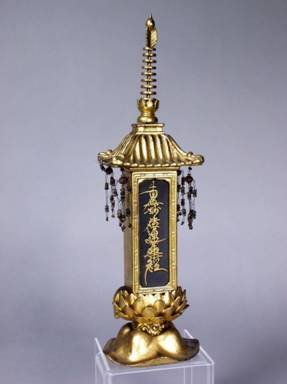
This portable altar, or zushi, was produced in the early 19th century for Honkokuji Temple in the eastern hills of Kyoto, in what is now the ward of Yamashina. The altar is associated with the Nichiren Sect, one of the main schools of Buddhism in Japan. Nichiren Shonin (1222–1282) was a Buddhist priest whose teachings focus on the Lotus Sutra doctrine as the sole correct path to save humanity. The thirteen figures on the zushi altar are symmetrically arranged around a central pagoda and the invocation
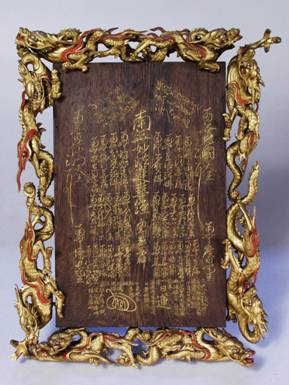
namu myoho renge kyo (“Praise to the wonderful dharma of the Lotus Sutra”). Behind it is a small plate with a transfer of Nichiren's inscription of the Gohonzon mandara (Holy Object Mandala). Statuettes of Buddhas and bodhisattvas are on both sides of the pagoda; in each corner are the Four Heavenly Kings, Shitenno, who watch over the world and Buddhist teachings. In the lower section of the altar is the central figure, the terrifying looking Kishimojin. Kishimojin (Sanskrit: Hariti) is a female demon who adopted Buddhism and became a protector deity of the Lotus Sutra and of children. The figure forms a central figure on the altar, flanked by statuettes of the bodhisattvas Fugen on a white elephant and Monju on a blue lion.
In 2005, conservators at the National Gallery discovered additional hidden inscriptions elucidating not only the origin of the altar, but also where it had travelled. The inscriptions refer to its restoration at the Onjuin Temple in Nakayama in 1850.
However, the subsequent history of the altar and how it got to Europe remain unclear. Correspondence with H. Saenger suggest that he had personally acquired the objects in Japan, but the sale of an altar directly by Buddhist monks is extremely unlikely for religious reasons. Jindřich Čadík explained that when the offer came from Hamburg in the early 20th century, museum director Škorpil did not hesitate “… and purchased the entire collection under exceptionally favourable terms of payment.” In the following years, additional offers and objects came to Pilsen from Hamburg.
The altar and other Japanese and Chinese objects have been part of the museum’s permanent exhibition since 1913. (JMl)